

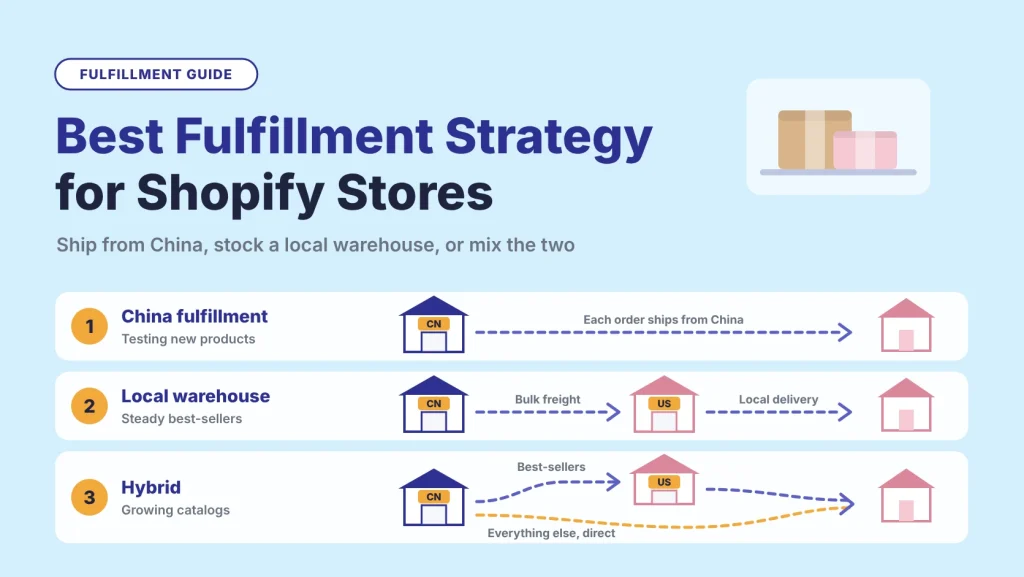
The best fulfillment strategy for Shopify stores that sell abroad depends on three things. Where are your buyers, how steady is demand, and how much cash can you tie up in stock? Many stores end up choosing between shipping each order from China, holding stock in a warehouse in their main market, or a hybrid of both.
Below, we compare the three with real costs, delivery times and the duty rules for each market. Then we show which SKUs to move first and how to grow in stages.
What Is the Best Fulfillment Strategy for Shopify?
There’s no single best setup, but there is a common path. For stores that make or source their products in China, the best fulfillment strategy for Shopify often starts with shipping from China. Then, once sales hold steady, proven best-sellers move closer to buyers. That way, cash stays free while you test products, and you pay for speed only where it earns its keep.
Shopify’s cross-border guide for merchants in China points the same way. It rates an overseas warehouse at 2 to 5 days of delivery but high on capital, and suggests one only once order volume is stable at about 10 to 20 or more orders a day. For testing and low volumes, its table points to fulfilling from China. In between, at 5 to 10 orders a day, it suggests a virtual overseas warehouse, where parcels leave China with local carrier labels already printed.
In short:
- Testing products or selling a wide catalog: ship each order from China.
- Steady best-sellers in one main market: stock them in a local warehouse.
- A mix of both: keep best-sellers local and ship everything else from China.
Fulfillment vs Shipping in Shopify Terms
The two words often get mixed up, but Shopify’s Help Center defines two separate time frames. Fulfillment time runs from the moment a customer places an order until the parcel reaches the carrier. Transit time then runs from carrier pickup until the parcel arrives at the customer’s address.
So fulfillment runs from receiving stock through storing, picking, packing and shipping, while shipping itself is the trip. As Shopify’s blog puts it, shipping “is a component of fulfillment and refers to the actual transit of the package.”
The split matters for planning. Your fulfillment model decides where stock sits and how fast orders leave the warehouse. Your shipping method then decides how long the trip takes and what it costs. Buyers only see the total, so the best fulfillment strategy for Shopify sets both together.
Three Models Behind the Best Fulfillment Strategy for Shopify
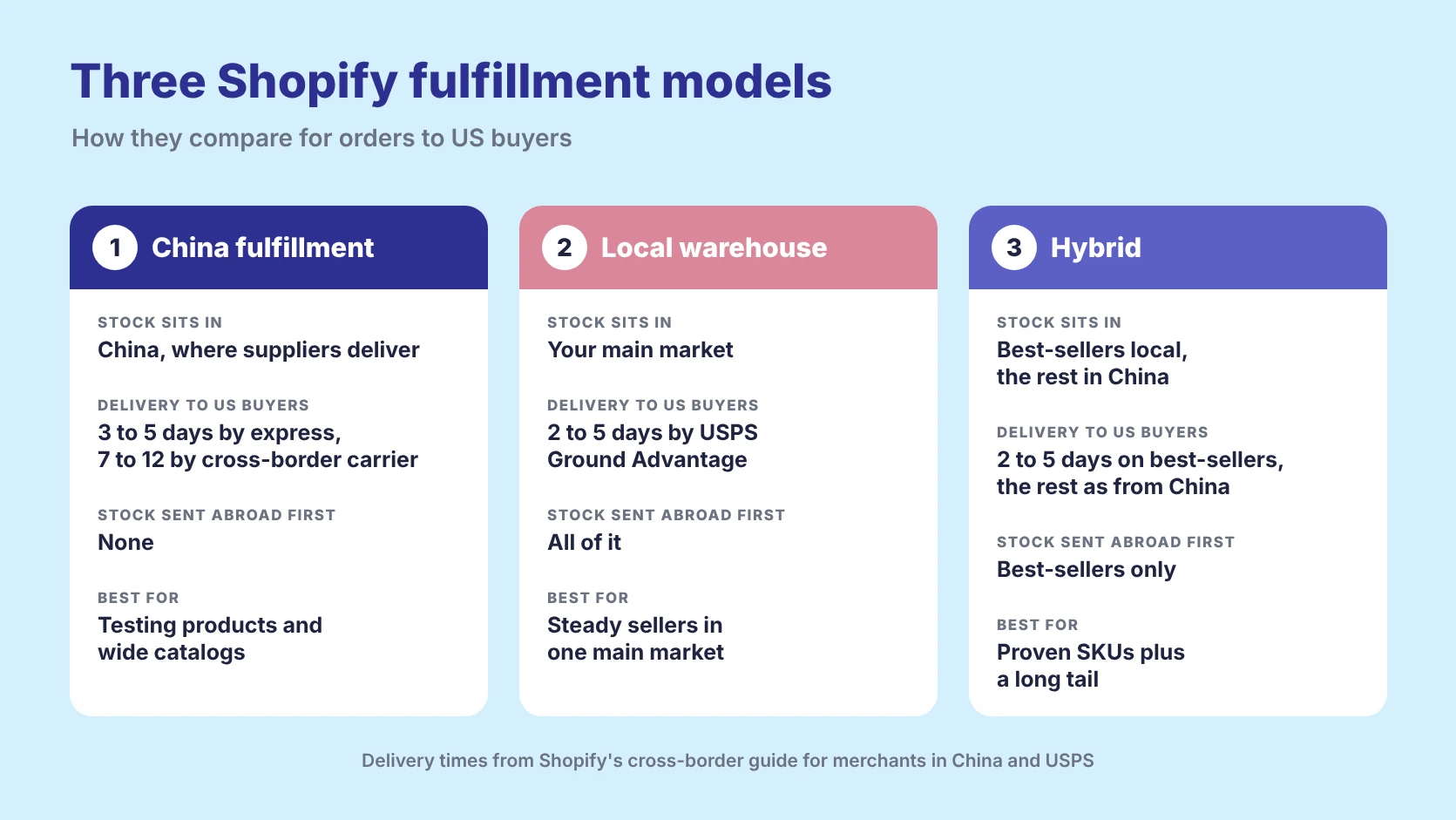
International orders come down to three main fulfillment models, with self-fulfillment and dropshipping at the edges. The image compares the three, and our China vs US fulfillment guide goes deeper on the first two.
1. China Fulfillment for Shopify Orders
Your stock stays in a China warehouse, where your suppliers deliver it, and each order ships to the buyer as its own parcel. A 3PL there receives goods from your suppliers, stores them and packs orders as they arrive from your store. Tracking then flows back to Shopify.
Speed depends on the shipping method. Shopify’s cross-border guide gives 3 to 5 days for international express, and 7 to 12 days to the US and Europe for specialized cross-border carriers.
The big plus is cash flow. Nothing goes abroad before it sells, and slow sellers never leave the source. For new stores still testing products, it’s often the best fulfillment strategy for Shopify.
2. A Local Warehouse in Your Main Market
Here, you ship stock in bulk by sea or air to a 3PL in the US, the EU or another main market. Orders then ship domestically, and USPS expects Ground Advantage parcels to arrive in 2 to 5 days.
The trade-off is upfront cost. You pay freight, duties and receiving fees before a single unit sells, and many US 3PLs charge a monthly minimum. Unsold stock also ends up far from your factory, where moving it again costs more. For steady sellers in one main market, though, it’s often the best fulfillment strategy for Shopify.
3. A Hybrid of Local Stock and China Fulfillment
A hybrid setup keeps best-sellers in a local warehouse and ships the rest of the catalog from China. Buyers get fast delivery on the products most of them order, while new and slow-selling SKUs stay at the source. In Shopify, you add each warehouse as a location and set order routing rules that decide which location fulfills each order.
Our guide to hybrid fulfillment covers how to split stock between a China 3PL and a US warehouse. The hard part is deciding which SKUs move, and ABC analysis (below) gives you a method.
Where Self-Fulfillment and Dropshipping Fit
Shopify notes that “You can fulfill orders yourself, use a fulfillment service, or combine both methods.” Packing your own orders is still common. In Radial’s 2025 survey of 200 retail decision-makers, 60% of brands under $50 million in revenue still fulfilled in-house from a single distribution center.
For stores at that stage, Shopify cites Red Stag Fulfillment’s analysis that the break-even point for outsourcing falls between 1,000 and 3,000 orders a month. With dropshipping, the supplier ships straight to your customer, but Shopify’s guide puts delivery at 15 to 40 days, so it suits product tests more than repeat buyers.
What the Best Fulfillment Strategy for Shopify Costs
The routes differ in timing as much as in price. From China, you pay per parcel as orders come in. With a local warehouse, you pay freight, duties and receiving months before stock sells, then pay again for each order.
Here are typical figures for each part, as of November 2026:
- Parcels from China: a 1 kg order costs about $9 to $14 on a dedicated ecommerce line and $24 to $35 by express, before duties (see our guide to China shipping costs).
- Sea freight: Freightos put China to the US West Coast at $8,460 per 40 ft container in its November 17 update.
- Air freight: in the same update, Freightos’ index for China to North America rose 16% to $9.25 per kg.
- US 3PL fees: The Fulfillment Advisor gives 2026 averages of $8.75 per pallet to receive, $19.37 per pallet per month to store, and $2.73 per order plus $0.48 per item to pick and pack, or $3.21 for a one-item order. Its average monthly minimum is $752.08.
- Last mile in the US: USPS Ground Advantage charges $9.04 to $16.30 by zone for a 1 kg commercial parcel (its 3 lb price), at holiday prices valid from October 4, 2026 to January 17, 2027.
- US import fees: a 0.3464% processing fee per formal entry (at least $34.58, at most $670.86), plus 0.125% for harbor maintenance on sea cargo. An automated informal entry, such as a single parcel, pays $2.77.
One Order Priced Three Ways
Take an item of about 1 kg packed, sold one per order to a US buyer.
One order of about 1 kg packed, to a US buyer, before duties (November 2026 figures)
Cost line | China, dedicated line | China, express | US warehouse, stocked by sea |
Freight to the US | In the parcel price | In the parcel price | About $1.69 ($8,460 for 5,000 units) |
Pick and pack | China 3PL’s fee | China 3PL’s fee | $3.21 for one item |
Delivery to the buyer | About $9 to $14 | About $24 to $35 | $9.04 to $16.30 (USPS, 3 lb price) |
Duties | Paid per parcel, often DDP | Paid per parcel, often DDP | Paid at import, before the stock sells |
Delivery time | About 7 to 12 days | About 3 to 5 days | About 2 to 5 days |
On these figures, a US warehouse stocked by sea costs about $14 to $21 per order. That assumes a full container of one product, before storage, receiving, port, trucking, broker and entry fees. Even so, it beats express on price and a dedicated line on speed. Restock by air instead, at $9.25 per kg, and the same order costs about $22 to $29.
A dedicated line from China, meanwhile, costs about $9 to $14 plus handling, with no stock paid for in advance. Each parcel does need its own customs entry, which adds that $2.77 fee unless the line’s price includes it. So the best fulfillment strategy for Shopify depends on whether speed or cash matters more for each SKU.
US Duties Now Apply on Both Routes
For US orders, duties no longer separate the two routes. The US suspended duty-free entry for parcels worth $800 or less from China on May 2, 2025, and for all countries on August 29, 2025. The law ends that exemption for good on July 1, 2027.
As a result, each parcel from China now clears customs and pays any duty owed, much like a container does. What changes is timing. Bulk stock pays duty at import, before you sell it, while a DDP parcel pays as each order ships.
On a given day, the same product pays the same tariff rate on either route. But rates can change between a bulk import and later parcels, and declared values can differ, so check each product’s HTS code and value with a customs broker before you compare.
Shopify International Shipping Rules for Duties and Delivery Dates
Two choices shape how international orders feel to buyers: who pays duties, and which delivery date the store promises. Both sit in your Shopify settings.
Show Duties at Checkout
Shopify can collect duties and import taxes at checkout, so buyers don’t face a bill at the door. Its requirements include a carrier that supports DDP labels and HS codes on your products, and it doesn’t work with Shopify Fulfillment Network. Shopify also reminds sellers that “Duties and import taxes apply to all US imports, regardless of the value of the shipment.”
Surprise charges cost sales. In DHL’s 2026 survey of 1,000 US shoppers, 62% said unexpected customs or tax charges had made them abandon online purchases.
Shopify’s Managed Markets is open to stores based in the US, and to some in Canada and the UK. With Global-e as merchant of record, it ships duty paid to most destinations. Since August 24, 2026, it no longer offers duty-unpaid delivery wherever it supports DDP.
Set Delivery Dates by Shipping Method
Promise what each method usually delivers, not its best case. Shopify’s guide lists 3 to 5 days for international express, 7 to 12 days to the US and Europe for cross-border carriers, and 20 to 40 days for economy channels such as China Post. It also warns that “Peak seasons can add 10-15 days to delivery times.”
Chinese New Year falls on February 6, 2027, so plan stock and delivery dates around it. Returns need the same planning. Shopify notes that “For many cross-border orders, return shipping costs more than the product value.” It suggests physical returns only for items of $100 or more, or suspected fraud.
Worldwide Shipping and Fulfillment Rules by Region
Low-value parcels no longer enter most big markets free of duty or tax, and these rules shape the best fulfillment strategy for Shopify in each market.
Rules for low-value parcels in main markets (as of November 2026)
Market | Low-value parcel rule | What it means |
United States | Duty-free entry up to $800 suspended since August 29, 2025 (China: May 2, 2025); ended by law from July 1, 2027 | Each parcel clears customs and pays any duty owed |
European Union | €3 duty per distinct item (July 1, 2026 to July 1, 2028), plus a €2 handling fee per distinct item since November 1, 2026; IOSS for VAT up to €150 | Each distinct item adds €5 |
United Kingdom | Great Britain: VAT charged at the point of sale on parcels of £135 or less, still duty free; rules to end that relief due by October 2028 | Price VAT in; plan for duty later |
Canada | Courier parcels from China: duty and tax free only up to CAD 20 | Most orders owe duty and tax |
Australia | No duty on most goods up to A$1,000, but 10% GST, charged by registered sellers at checkout | Price GST in |
In the EU, “item” follows tariff classification, so a parcel with two kinds of product pays twice. Bulk stock in an EU warehouse skips the €3 duty and, for now, the €2 fee, but pays normal duty and import VAT. And since IOSS doesn’t cover goods stored in the EU, selling them needs an EU VAT registration.
How to Build Your Order Fulfillment Strategy
An order fulfillment strategy sets where each SKU sits, how each order ships and when that should change. Your own order data, not a template, points to the best fulfillment strategy for Shopify.
Start with your last 90 days of orders. If most go to one country, a local warehouse there can pay off. If they’re spread across many, one China warehouse keeps all your stock in a single place.
Rank SKUs With ABC Analysis
ABC analysis ranks products by the value they bring. As NetSuite puts it, “ABC analysis identifies the 20% of goods that deliver about 80% of the value.” In its classes, A items make up 10% to 20% of inventory and 70% to 80% of annual consumption value. C items make up 50% of inventory but only 5% of the value.
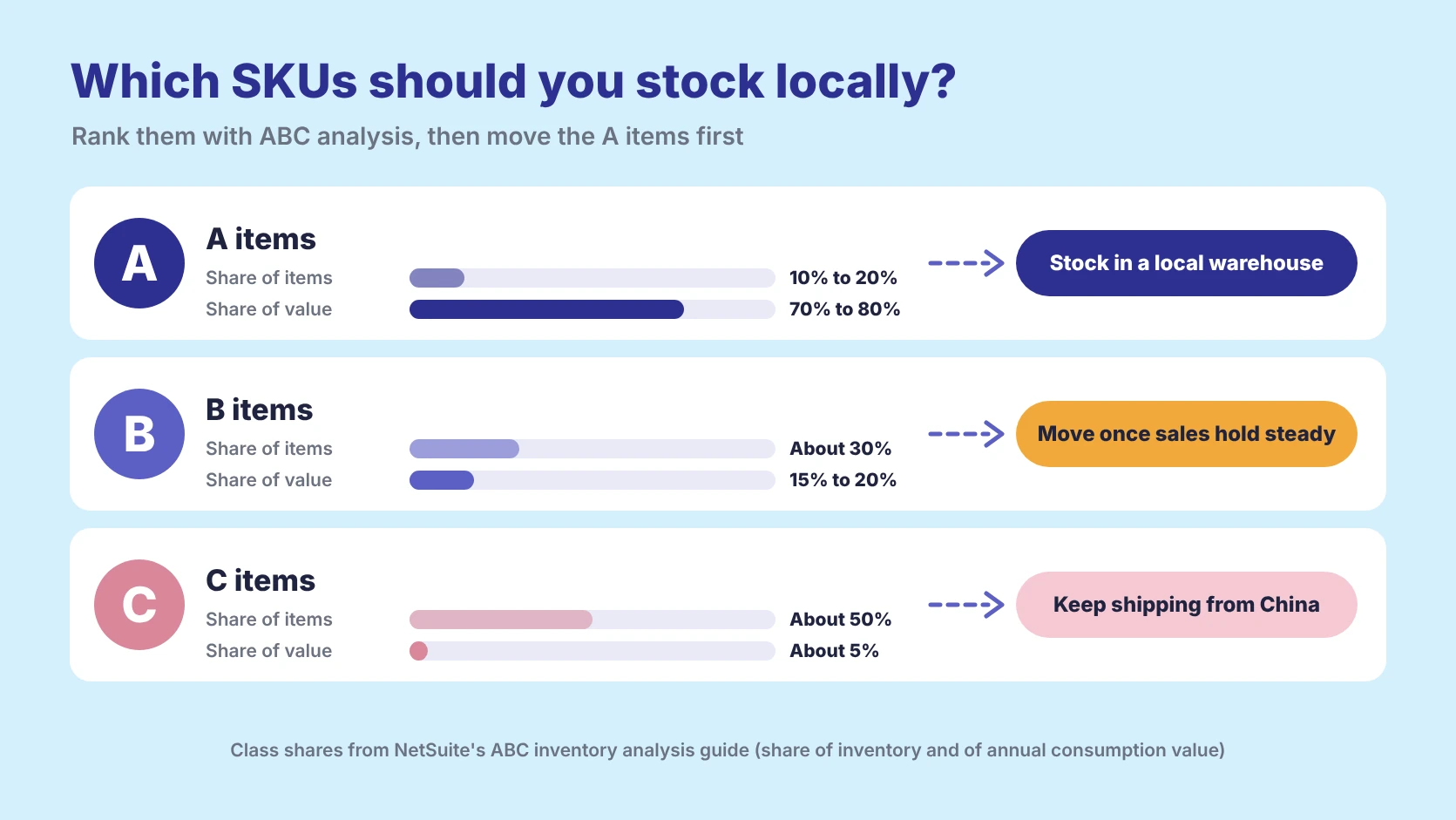
For a store with many SKUs, this is where the best fulfillment strategy for Shopify gets specific. A items are your first candidates for a local warehouse. C items can stay in China for good, and B items move once their sales hold steady.
Size Packaging Before You Pick a Route
Carriers bill the higher of actual and dimensional weight. For international shipments, DHL, FedEx and UPS multiply a parcel’s length, width and height in centimeters, then divide by 5,000. So a 500 g product in a 30 × 20 × 10 cm box bills as 1.2 kg. UPS then rounds express weights up to the next half kilo, making it 1.5 kg.
Inside the US, USPS has used a divisor of 139 since July 12, 2026, for parcels over one cubic foot (1,728 cubic inches). Smaller boxes skip that rule, but prices still step up by the pound. A 500 g item weighs 1.1 lb, so it pays the 2 lb price.
Choosing the Best Fulfillment Strategy for Shopify by Stage
Many stores move through three stages, and each step can be reversed:
- Start: ship every order from China while you test products and markets. Stock stays in one place, and cash goes into products rather than freight.
- Grow: move A items to a local warehouse once their sales are steady, and keep shipping the rest from China.
- Scale: add stock in each main market as volume grows, and keep China for new launches and the long tail.
None of these choices is permanent. If a local SKU slows down, stop restocking it and let China fulfillment take over again. That flexibility is why the best fulfillment strategy for Shopify stores tends to change as they grow.
Mistakes That Undo the Best Fulfillment Strategy for Shopify
Even the best fulfillment strategy for Shopify fails if the details slip. These five mistakes are common and costly:
- Moving stock before demand is proven. Send $50,000 of stock to a US warehouse, sell 60%, and $20,000 of it sits on shelves, paying storage every month.
- Paying for speed buyers don’t value. In Baymard Institute’s list of reasons US online shoppers give for abandoning an order, leaving out those just browsing, 20% cite slow delivery and 40% cite extra costs such as shipping, tax and fees.
- Ignoring box size. Dimensional weight can make an oversized box cost more to ship than the product inside.
- Leaving duties for the door. Under duty-unpaid terms, carriers may charge extra to collect duties on delivery, on top of the duties themselves.
- Comparing price per parcel only. A cheap line that runs late costs more once refunds and support tickets add up, so compare the cost per delivered order.
FF Logistics and the Best Fulfillment Strategy for Shopify
If China is part of your best fulfillment strategy for Shopify, we run that side, storing stock in our China warehouse, where your suppliers deliver it, and shipping each order from there. Our fulfillment services include:
- a Shopify connection that needs only your store link, with orders syncing automatically and tracking going back to your store;
- free receiving, and free storage for the first 90 days, then $0.30 per cubic meter per day;
- handling from $0.18 per order, with basic pick and pack included;
- same-day dispatch for orders that reach us by 11:00 a.m. China time;
- fast express to the US in 2 to 4 days (3 to 7 days on the economy option), and dedicated lines in 5 to 7 days (6 to 12 on economy);
- DDP options, so duties can be paid before delivery.
Our guide to China fulfillment for Shopify shows how the connection and order flow work, step by step.
Frequently Asked Questions
How Do I Fulfill Orders on Shopify?
If you pack orders yourself, open the order in your Shopify admin and click Mark as fulfilled. Add the tracking number, choose whether to notify the customer, and confirm. With a fulfillment service app, the 3PL gets the order instead, and with automatic fulfillment, “fulfillment is automatically requested when the order is paid.” For dropshipping, the order details flow from your store to your supplier, who ships to your customer.
What Are the 7 Steps of Order Fulfillment?
A common list, set out by NetSuite, is receiving inventory, storage, order picking, order packing, shipping, delivery and returns. Some sources count six or eight stages, but the order stays the same. Our guide to the order fulfillment process explains each stage.
What Happened to Shopify Fulfillment Network?
In May 2023, Shopify agreed to sell most of its logistics business to Flexport, which became Shopify’s official logistics partner. Today, Shopify presents its Fulfillment Network as a network of partner 3PLs, with Flexport as the preferred partner. Its partners hold stock in warehouses near buyers, so it doesn’t replace shipping from China. Shopify’s duty collection at checkout also doesn’t work with it.
How Much Does Shopify Fulfillment Cost?
It depends on who fulfills your orders. In the US, a 3PL averages $2.73 per order plus $0.48 per item for pick and pack, and $19.37 per pallet per month for storage, according to The Fulfillment Advisor’s 2026 figures. Postage comes on top, such as $9.04 to $16.30 to send a 1 kg parcel by USPS Ground Advantage, at holiday prices valid until January 17, 2027. From China, a 1 kg order costs about $9 to $14 on a dedicated line, before duties.
When Should I Move Inventory to a US Warehouse?
Move a SKU once its US sales are steady, not after one good week. Shopify’s guide for merchants in China suggests an overseas warehouse only once order volume is stable at about 10 to 20 or more orders a day, with capital to invest. Start with your A items, and keep the rest in China until their numbers hold.
Is Shipping From China Still the Best Fulfillment Strategy for Shopify?
For testing products and long-tail SKUs, it often is. Stock stays in one place, nothing is paid to move it abroad in advance, and express can reach US buyers in 3 to 5 days. For US orders, duties now apply whichever way you ship, so the choice comes down to delivery promise, demand and cash flow. Low-value parcels to the UK and Australia still enter without duty, though the UK plans to end its relief, with rules due by October 2028.

