

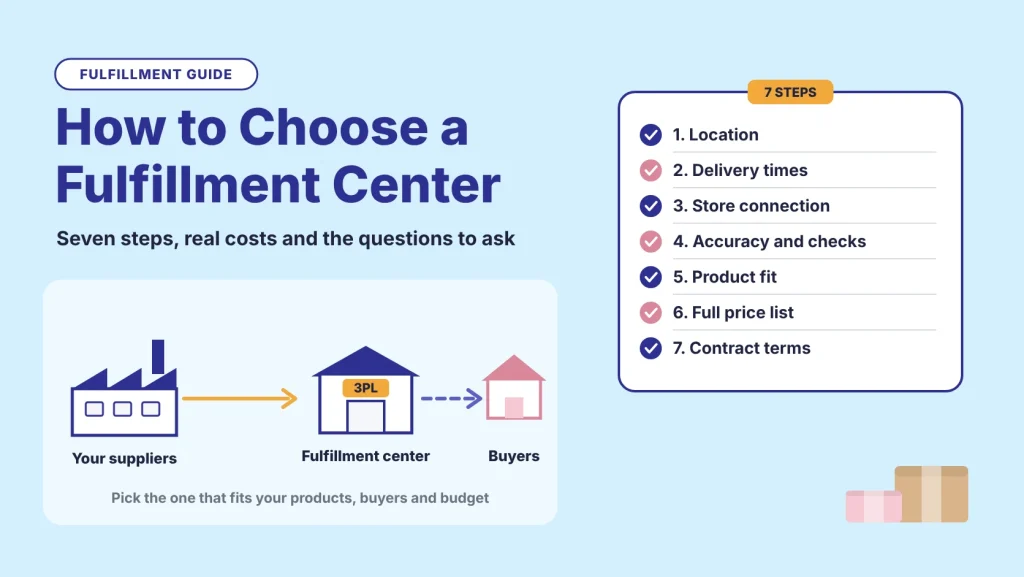
Learning how to choose a fulfillment center starts with four facts about your own store. Where are your buyers, where are your goods made, how many orders do you ship, and how fast do buyers expect them?
Those answers narrow the field quickly. Below, we walk through seven steps, from location to contract terms, with real prices from US and China warehouses and the questions to ask before you sign. If you’d like to see what happens inside one first, our guide to the fulfillment warehouse process follows stock from arrival to shipping.
When Does an Online Store Need a Fulfillment Center?
Most brands start by packing orders themselves. That works until packing eats the hours you need for products and marketing, or until orders start leaving late.
These are the usual signs it’s time to outsource:
- Packing and labeling take hours every day.
- Orders ship late during promotions or peak season.
- Stock comes from several suppliers, so you never have one clear count.
- You’re starting to sell in other countries.
You don’t need huge volume, either. In one 3PL marketplace’s intake data, two-thirds of brands looking for a 3PL shipped fewer than 500 orders a month.
Volume still matters, though, because some 3PLs charge a monthly minimum. In one 2026 pricing survey of US and Canadian 3PLs, the average reported minimum was $752.08 a month. So check whether your orders cover it before you sign.
If two or more of the signs above fit your store, it’s time to choose a fulfillment center.
How to Choose a Fulfillment Center in 7 Steps
Work through the steps in order. Each one shortens the list before you compare prices.
1. Decide Where Your Fulfillment Center Should Be
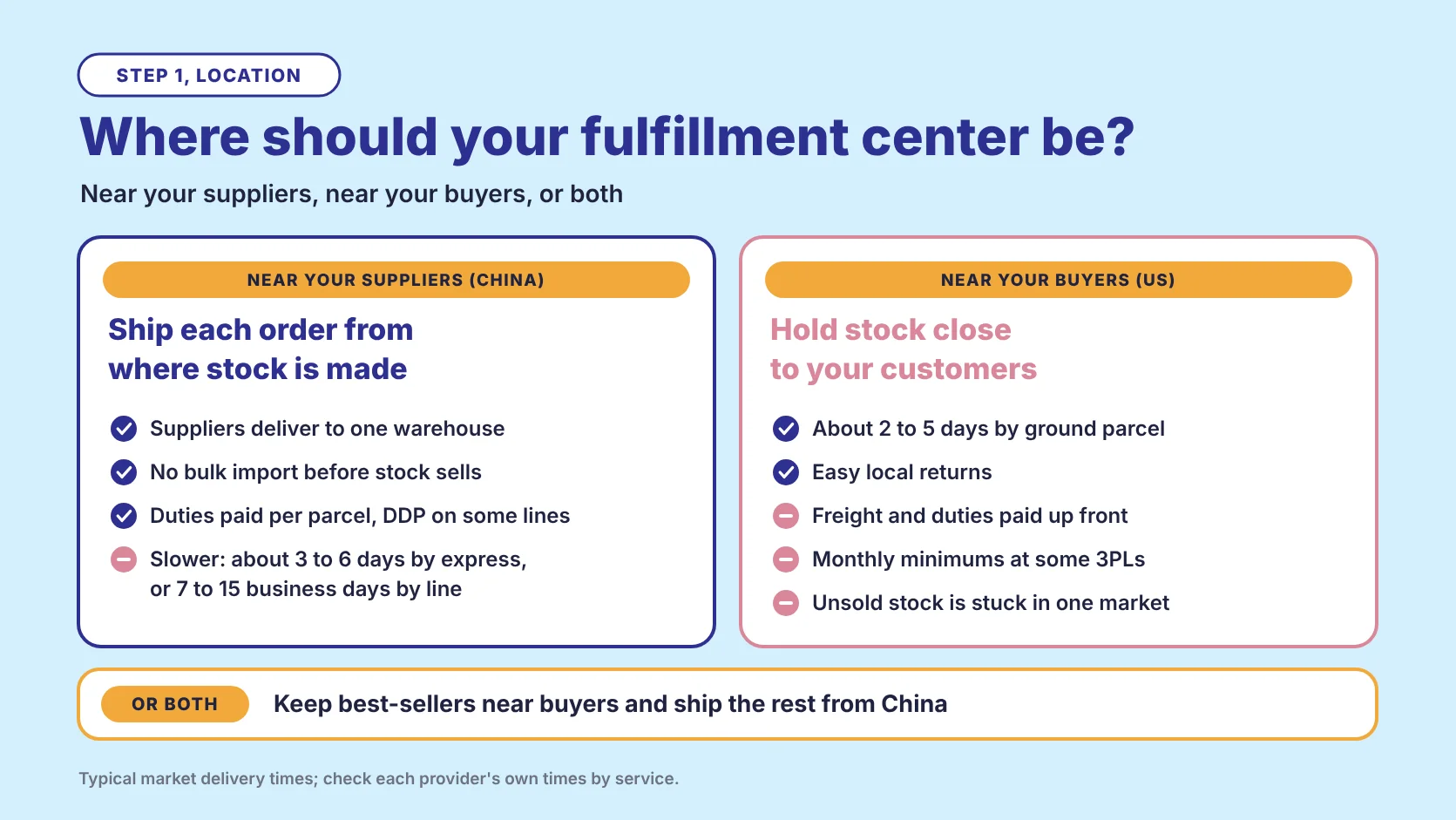
Location is the first thing to settle when you choose a fulfillment center, because it decides delivery speed and when you pay for stock. A fulfillment center near your suppliers ships each order from where the goods are made. One near your buyers delivers faster and makes returns easier, but you pay freight and duties before anything sells.
Every handoff on the way adds time, too. A World Bank director called logistics “the lifeblood of international trade” when the bank released its 2023 Logistics Performance Index. Its 2023 report found that the biggest delays occur at seaports, airports and other transfer hubs.
For brands that make products in China, the choice usually comes down to a China 3PL, a warehouse in your main market, or both. Our China vs US fulfillment guide compares the two.
2. Compare Delivery Times and Shipping Options
Ask for delivery times by service and by country, not one headline figure. From China, typical market times are about 3 to 6 days by express and 7 to 15 business days by dedicated ecommerce line. Inside the US, ground parcels take about 2 to 5 days.
Ask how often it meets those times, too. As a 2026 World Bank analysis put it, “For traders, reliability is at least as important as speed.” Then ask which lines it uses, its daily cutoff for same-day dispatch, and whether it offers duties-paid (DDP) shipping.
Those answers shape what your store can promise. Under the FTC’s mail order rule, sellers shipping to US buyers need a reasonable basis for any shipping time they state, or for shipping within 30 days if they state none. If an order will ship late, the seller must ask the buyer to accept the delay, or cancel the order and refund it in full. And when a fulfillment house causes the delay, the FTC holds the seller responsible, not the warehouse.
3. Check How It Connects to Your Store
Orders should reach the warehouse on their own, and tracking should come back the same way. So choose a fulfillment center that connects to your store directly. Ask which store platforms it connects to, how often orders sync, and whether stock levels update in your store. Then run a few test orders before you move all your stock.
4. Ask for Accuracy Rates and Inbound Checks
A good warehouse measures its errors and shares the numbers. So when you choose a fulfillment center, ask for its order accuracy, its inventory accuracy, and how long new stock takes to become available for sale.
For context, a 2026 benchmark study of warehouses and distribution centers found that the top fifth pick more than 99.7% of orders correctly. They also ship over 99.5% of orders on time and have new stock put away and recorded within 3.1 hours of arrival. These are best-in-class results, so treat them as a goal rather than the norm.
Ask what it checks when stock arrives, too: quantities, damage, the right product and labels. Also find out how fast it reports a problem, and whether it sends photos.
5. Match Its Experience to Your Products
It helps to choose a fulfillment center that already ships products like yours. Glass needs cushioning, and liquids need sealed caps. Kits need assembly, dated products need expiry tracking, and heat-sensitive goods may need climate control.
So ask how it packs items like yours, and ask for photos of packed orders. Check, too, whether it ships batteries or other regulated goods at all.
6. Get the Full Price List
It’s tempting to choose a fulfillment center on its pick and pack fee alone. But a low fee means little if storage, packaging, receiving or minimums make up the difference. Ask for every fee in writing, then price a normal month of your own orders, shipping included.
Ask how it picks box sizes, too, since an oversized box raises the dimensional weight that carriers bill. Our guide to China shipping costs gives typical parcel prices by weight.
7. Read the Contract Before You Sign
Before you choose a fulfillment center, read two clauses closely: who pays when goods are lost or damaged, and how you leave.
Under US commercial law (UCC section 7-204), a warehouse is liable for loss or damage caused by a lack of reasonable care. However, the storage agreement can cap that liability. You can ask for a higher limit in writing when you sign, though the warehouse may charge more for it. So compare the cap with the value of the stock you’ll keep there.
Caps are often set per pound. At 50 cents per pound, a figure some standard terms use, a lost 20 lb carton of serums would pay $10, whatever the serums cost. Claim deadlines matter too, since standard terms often require a written claim within 60 days of delivery or of learning about the loss, whichever comes first.
Also check the notice period, the fees to move stock out, and whether you can export your order data.
What a Fulfillment Center Costs
Costs come in two parts: the warehouse’s own fees, and shipping to the buyer. Here’s how the average US and Canadian 3PL compares with our prices in China, as of November 2026.
Average 3PL fees in the US and Canada vs FF Logistics prices in China (November 2026)
Cost | Average US and Canadian 3PL | FF Logistics (China) |
Setup | $373.06 average; 55% of 3PLs charge one | Free |
Receiving | $8.75 per pallet | Free |
Storage | $19.37 per pallet per month | Free for 90 days, then $0.30 per cubic meter per day (about $9 a month per cubic meter) |
Pick and pack, one item | $3.21 per order | From $0.18 per order, with basic pick and pack |
Shipping 1 kg to a US buyer | $9.04 to $16.30 by ground (billed as a 3 lb parcel) | About $9 to $14 by dedicated line, $24 to $35 by express (typical market prices) |
Getting stock there | Freight, duties and entry fees before anything sells | Suppliers deliver inside China; duties are paid per parcel |
The US and Canadian fees come from a 2026 pricing survey of 3PLs in both countries. US postage uses business rates, with holiday prices until January 17, 2027. China shipping prices are typical market ranges, before duties.
Fulfillment Center Costs per Order
Per order, that’s about $12.25 to $19.51 from a US 3PL (pick and pack plus postage). From China, FF’s starting handling fee plus a typical line price comes to about $9.18 to $14.18. The US figure leaves out receiving, storage, packaging, freight, duties and any monthly minimum. The China figure leaves out duties, any customs entry fees and the SKU fee.
So at our starting fee, the China route can cost less per order before duties, while the US route delivers faster. Before you choose a fulfillment center, price a normal month of your own orders both ways, minimums included.
Direct Distribution vs Fulfillment Center
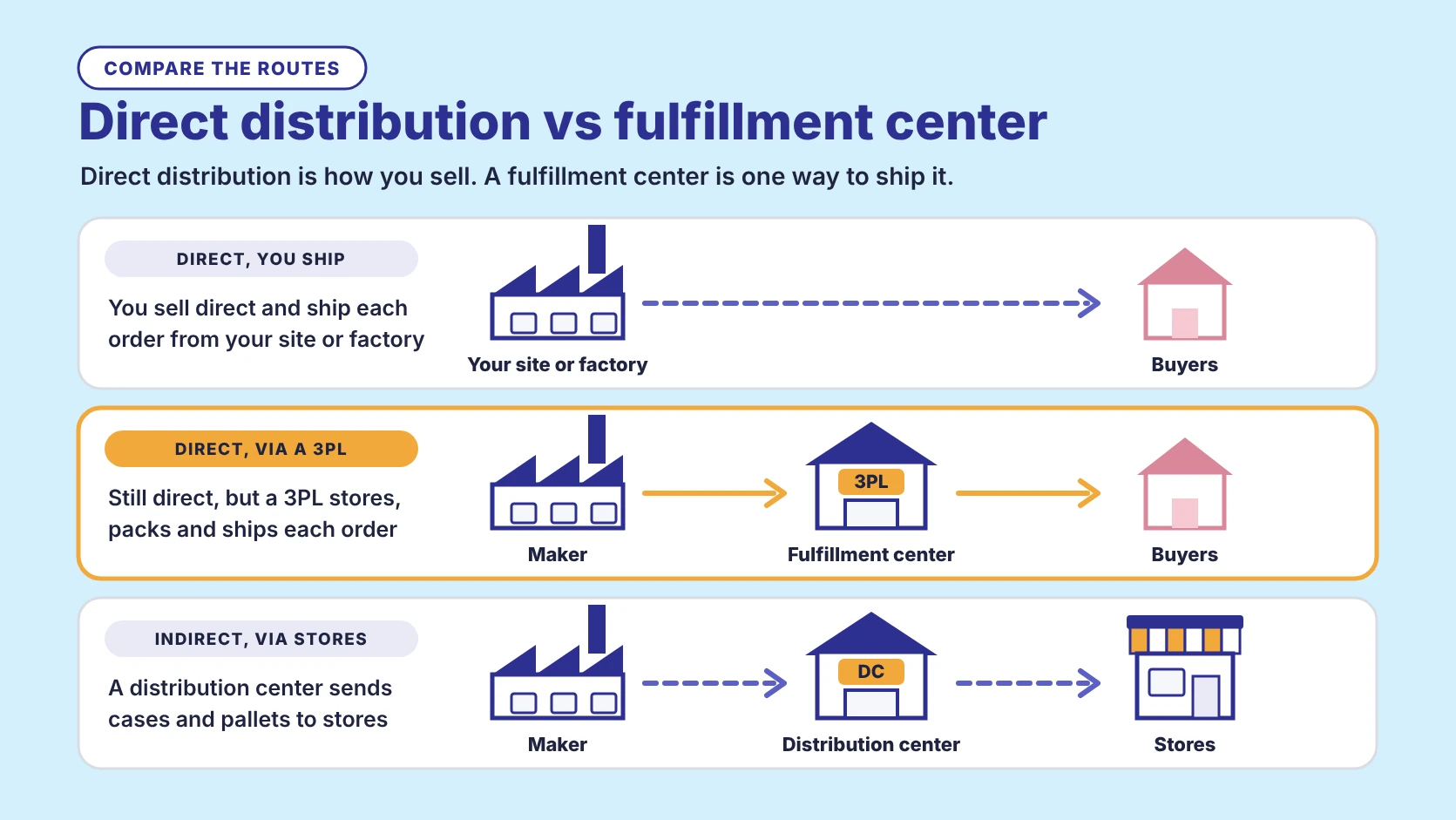
Direct distribution means selling straight to the end buyer, with no wholesaler or retailer in between. So it’s a choice of sales channel, not a type of building. You can run it two ways: ship orders yourself from your own site or the factory, or choose a fulfillment center to ship them for you.
Shipping yourself keeps control and costs little at low volume, but packing takes more of your time and space as orders grow. A fulfillment center keeps you selling direct while a 3PL stores, packs and ships each order. A distribution center is different again, since it serves the indirect route, sending cases and pallets to stores and wholesalers.
Direct distribution vs fulfillment center vs distribution center
Ship it yourself | Fulfillment center | Distribution center | |
Sales route | Direct to buyers | Direct to buyers | Indirect, through stores and wholesalers |
Who runs it | You or your factory | A 3PL | A retailer or a 3PL |
Goods leave as | Single parcels | Single parcels | Cases and pallets |
Best fit | Low volume or made-to-order goods | Growing online stores | Brands that sell through retail |
If packing is starting to take time away from everything else, that’s usually the moment to hand it to a 3PL.
Mistakes to Avoid When You Choose a Fulfillment Center
These five mistakes are easy to make before you sign:
- Comparing pick and pack fees only. Receiving, storage, packaging and minimums can cost more over a year than picking. So compare the total for a normal month of your orders.
- Moving all your stock on day one. Start with a few SKUs and some test orders. Then check accuracy, packing and tracking before you send the rest.
- Promising delivery times the warehouse can’t meet. Base your store’s delivery promise on the warehouse’s real times for each service, not its fastest one.
- Sending stock without labels or a packing list. Unlabeled cartons slow down receiving, and stock can’t sell until the warehouse logs it.
- Forgetting peak season. Ask how it handles the November and December rush, and whether holiday shipping prices apply. With a China 3PL, ask about Chinese New Year too, when many factories close and shipping capacity tightens.
How FF Logistics Answers These Questions
At FF Logistics, we run a China 3PL for online brands that ship parcels to buyers around the world. If you choose a fulfillment center in China, here’s how we answer the seven steps, so you can compare us with any other option.
Our Fulfillment Center Location and Speed
- Location: our office and fulfillment warehouse are in Shenzhen, in southern China, and your suppliers ship stock straight to the warehouse.
- Delivery times: express reaches the US in 2 to 4 days, or 3 to 7 days on economy. Dedicated lines take 5 to 7 days, or 6 to 12 on economy. Orders that reach us by 11:00 a.m. China time leave the same day, and DDP options let duties be paid before delivery.
- Store connection: orders sync to us automatically, and tracking goes back to your store. Smaller sellers can also send orders by spreadsheet or email.
Checks, Prices and Contract Terms
- Accuracy and checks: our average inventory accuracy and order accuracy are both 99.95%. When stock arrives, we check quantities, damage, the right product, labels, and batch and expiry details. If something’s wrong, you get photos and a report within 3 days.
- Product fit: we record expiry dates, ship stock by expiry date or oldest first, as you choose, and track batch numbers when needed. Our standard packing is a bubble bag inside a cardboard box, and we also handle kits, gift boxes, samples and custom packaging. We don’t list climate-controlled storage as a service, so ask before you send heat-sensitive products.
- Prices: setup and receiving are free, and storage is free for the first 90 days, then $0.30 per cubic meter per day. Handling starts at $0.18 per order with basic pick and pack included. There’s no minimum order quantity, and kitting is priced by the work each kit needs. A SKU fee depends on your product range, and shipping depends on the line and region.
- Contract terms: we compensate parcels lost or damaged in transit at twice the shipping fee, and you can add insurance for high-value goods. For stock inside our warehouse, we’ll confirm how losses are handled before it arrives.
You can read more about how we work on our fulfillment services page.
Frequently Asked Questions
What Is the Best Fulfillment Center?
No single fulfillment center is best for every brand. The best one fits your products, your buyers and your order volume.
For example, a brand that makes its goods in China and sells in many countries often does well with a China 3PL. A brand with fast-selling stock and mostly US buyers may do better with a US warehouse. To choose a fulfillment center, score each option on the seven steps above, then run test orders with your top two.
Is There a Difference Between a Fulfillment Center and a Warehouse?
Yes. A warehouse mainly stores goods, often in bulk and for months at a time. By contrast, a fulfillment center holds stock for a shorter time and ships single orders straight to buyers, so picking, packing and shipping speed matter more. A distribution center is a third type: it moves stock on to stores and other businesses in cartons and pallets, usually on a fixed schedule.
How Much Does a Fulfillment Center Cost?
Expect three kinds of cost: setup, monthly warehouse fees and shipping. In one 2026 pricing survey of US and Canadian 3PLs, picking and packing a one-item order averaged $3.21, and storage $19.37 per pallet a month. Just over half of them (55%) charge a setup fee, and the average reported fee was $373.06.
At FF Logistics, setup and receiving are free, storage is free for 90 days, and handling starts at $0.18 per order. Shipping comes on top. On the market, a 1 kg parcel by dedicated line from China to the US typically costs about $9 to $14 before duties, so ask any 3PL for a full quote with shipping included.
How Do I Set Up a Fulfillment Center?
For most online stores, setting up means onboarding with a 3PL rather than building your own. Once you choose a fulfillment center, the usual steps are:
- Connect your store so orders and tracking sync.
- Send your product list with SKUs, barcodes, weights and sizes.
- Ship your first stock with a packing list.
- Let the warehouse check, count and shelve it.
- Run test orders, then go live.
Running your own fulfillment center means renting space and buying racking, packing stations and shipping software. You also hire staff and open carrier accounts, so it usually pays off only at high, steady volume. Staff alone add up quickly. In 2025, stock clerks and order fillers in US warehousing earned a median $21.49 an hour, according to the Bureau of Labor Statistics.
What Are the 7 Steps of Order Fulfillment?
There’s no official list, and guides give anywhere from five to eight steps. A common seven are receiving, storage, order processing, picking, packing, shipping, and delivery and returns. Our guide to the order fulfillment process explains each one, and it’s worth asking any 3PL how it handles all seven.
Does a Fulfillment Center Need to Be Near Me?
No. It needs to be close to your buyers or your suppliers, not to your office. You send stock to it, it ships your orders, and you track everything online, so many brands use a fulfillment center in another country. When you choose a fulfillment center, compare delivery times to your buyers first, then costs.

