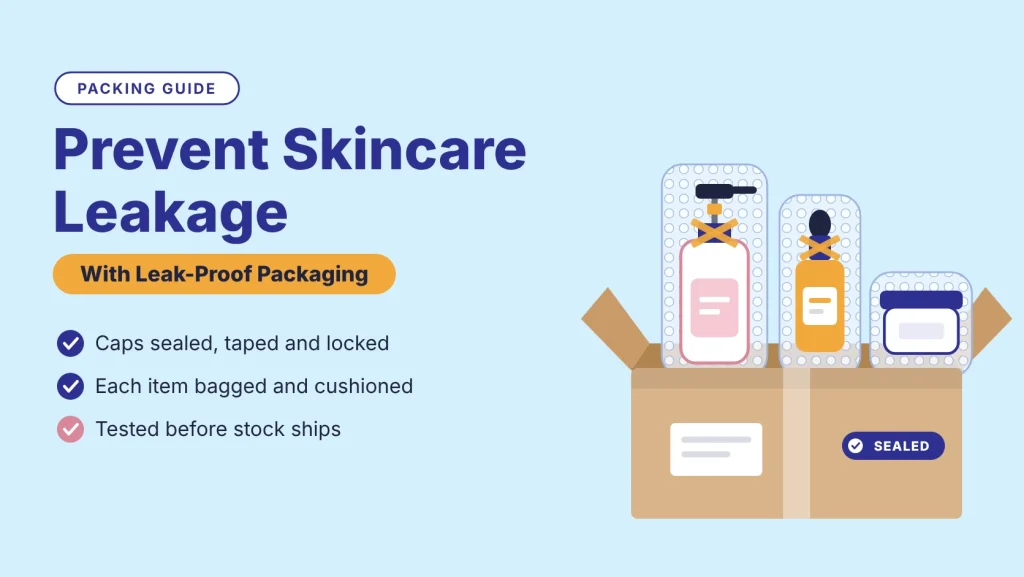
A loose cap can ruin more than one bottle. When a serum leaks in transit, it can soak the other products, the insert card and the box, so your customer opens a sticky parcel. You then pay for a replacement, and the customer may think twice before ordering again. To prevent skincare leakage, you have to stop it in three places: the bottle, the packaging around it and the route it travels.
This guide explains why skincare leaks on the way from China and which leak-proof packaging works. It also covers the tests that catch weak closures early, and what we do at FF Logistics when we pack your orders.
Why Skincare Leakage Happens in Transit
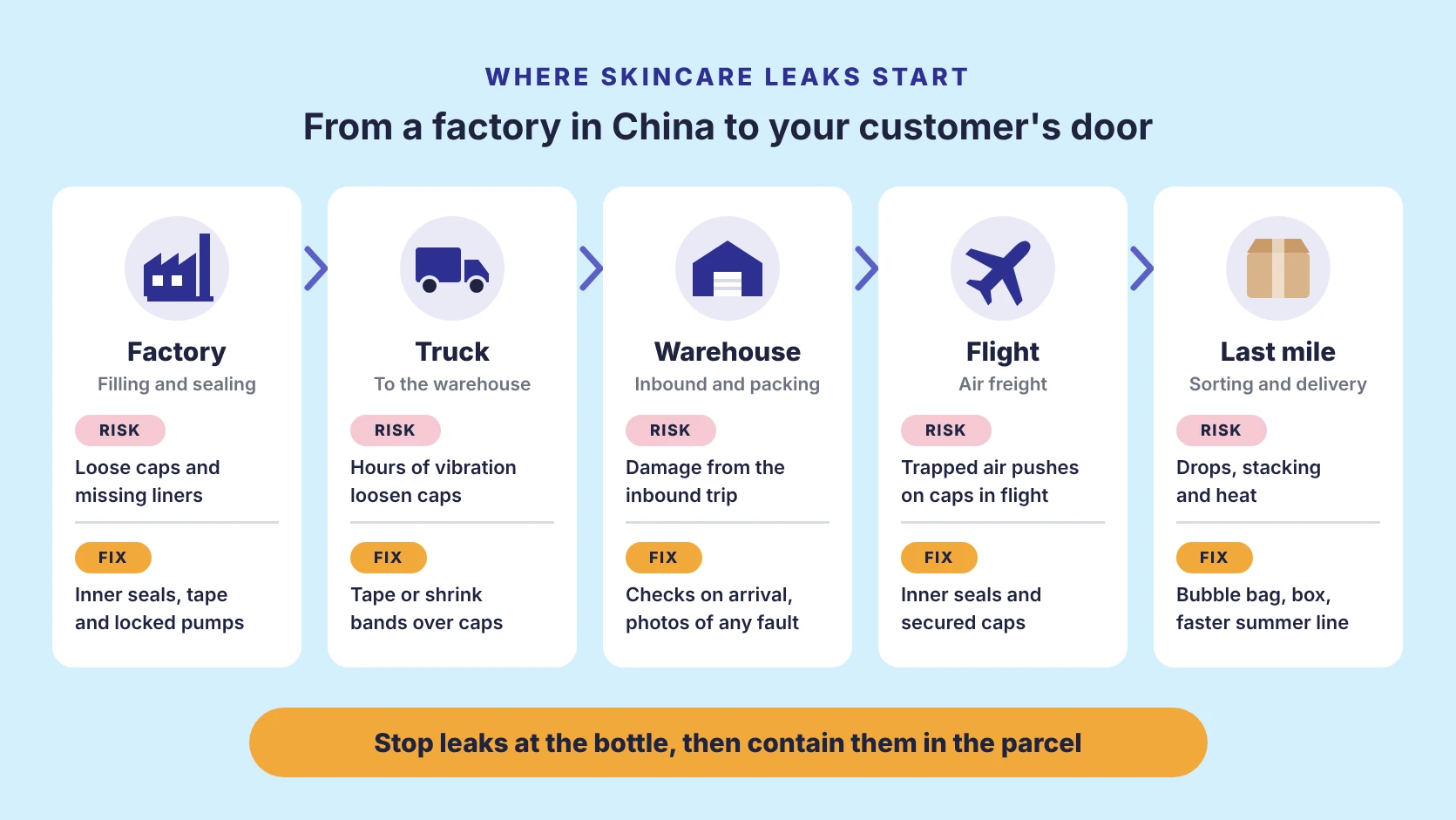
Many leaks start at a closure that can’t handle the trip. On the way to your customer, carriers drop, stack and fly parcels, and each step tests the seal. So before you change your packaging, it helps to know what pushes product out of a bottle.
Pressure and Heat on the Way
In flight, the air pressure around a parcel drops, but the air sealed inside a bottle doesn’t. As a result, that air pushes product toward any gap in the closure. ASTM’s standard for testing packaging at altitude notes that parcels on feeder aircraft can reach 19,000 feet (5,791 m). Heat adds to the push, because warm liquids expand and thin out.
That’s why US rules for hazardous liquids sent by air require packagings built “to prevent leakage that may be caused by changes in altitude and temperature”. Most skincare isn’t hazardous, but the same forces act on every serum on the plane.
Vibration, Drops and Stacking
Trucks, conveyors and sorting belts shake parcels at every stage. Over time, that vibration can loosen a screw cap, which is why FedEx tells shippers to “tape the closure shut to prevent the top from vibrating off”. Drops and heavy parcels stacked on top add force too. As a result, a pump head can press down and push product out, while a glass dropper can break.
Weak or Mismatched Closures
Some leaks start at the factory. A cap that isn’t tight enough, a missing liner or a pump that doesn’t fit the bottle neck can leak however well you pack it. Thin serums and oils also find small gaps faster than thick creams. In other words, packaging can contain a leak, but only the closure can stop one.
Leak-Proof Packaging for Skincare
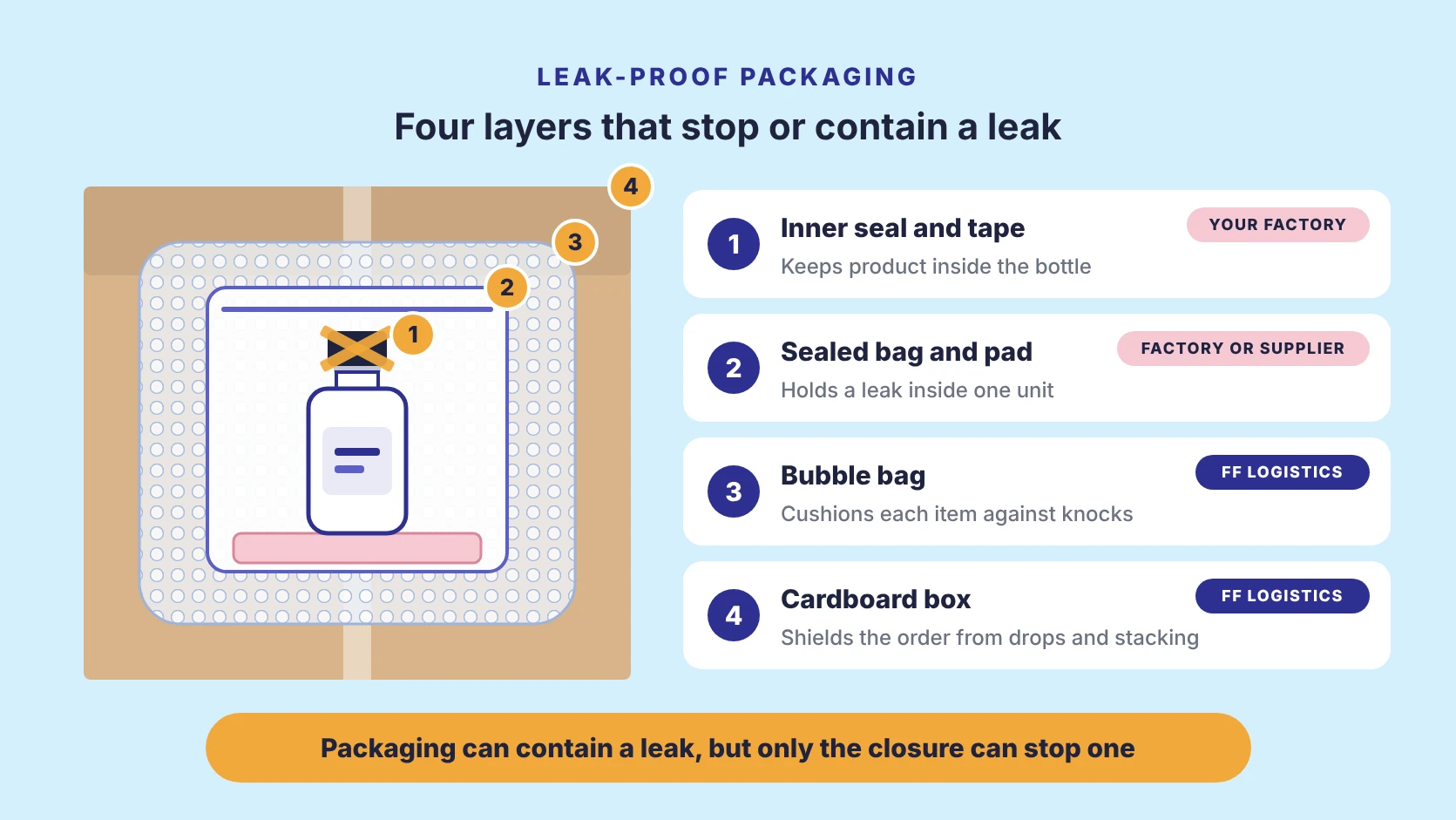
Leak-proof packaging works in layers. The closure keeps product in the bottle, and a sealed bag keeps any leak away from the rest of the order. Then the box and cushioning protect both from knocks.
Carriers ask for the same layers. For example, FedEx’s liquid shipping guide recommends watertight plastic containers and an absorbent such as paper towels or cotton balls. It also says to fill any empty space with packing paper or bubble packaging. Similarly, DHL’s cosmetics packing advice says to seal liquids “in a plastic bag before putting into a strong double wall box”.
Leak-proof packaging layers for skincare
Layer | What it does | Who adds it |
Inner seal, plus tape, a shrink band or a pump lock | Keeps the closure shut and the product inside | Your factory |
Sealed bag around each bottle | Keeps a leak inside one unit | Your factory or packaging supplier |
Absorbent pad | Soaks up a spill before it spreads | Your factory or packaging supplier |
Bubble bag | Cushions each item against knocks | FF Logistics |
Cardboard box | Shields the order from drops and stacking | FF Logistics |
No package stays leak-proof in every condition, though. So treat the term as a goal you prove with tests, rather than a promise on a supplier’s quote.
US Mail Rules for Liquids
Some carriers turn this advice into rules. If your line hands US orders to USPS as domestic parcels, USPS mail rules ask for screw caps with “a minimum of one and one-half turns”. So check the neck finish in your bottle spec: a 410 finish has about a turn and a half of thread, while a 400 has about one turn.
Breakable containers, including glass and plastic, that hold more than 4 fluid ounces (about 118 ml) also need triple packaging. That means absorbent that can soak up all the liquid, a sealed leakproof second container and a strong outer box. So a 30 ml serum sits under the line, while a 200 ml cleanser doesn’t.
USPS accepts containers certified under ISTA’s Test Procedure 3A as an alternative, with written test results on request. It also asks for a liquid marking and orientation arrows on the box. Even so, FedEx notes that a “This End Up” mark “doesn’t guarantee” a box stays upright in transit, so pack as if it won’t.
How to Prevent Skincare Leakage at the Factory
The cheapest place to prevent skincare leakage is the filling line. So agree on these steps with your factory before mass production, and write them into your purchase order:
- Add an inner seal. For jars and screw-cap bottles, an induction-sealed foil liner bonds to the rim, so product stays in even if the cap loosens.
- Set a cap torque. Ask the factory to check how tight caps are on samples from each run, so you can see each run meets the spec.
- Tape or band each cap. A strip of tape or a heat-shrink band helps stop the cap from vibrating loose. FedEx suggests strapping tape in an X over the closure.
- Leave headspace. Don’t fill bottles to the brim, because the extra space gives the liquid room to expand without bursting the container.
- Bag liquids one by one. A sealed bag around each bottle keeps one leak from spreading through a carton or an order.
These steps mirror the rules for riskier liquids. For hazardous liquids sent by air, US rules list adhesive tape, locking rings and induction heat seals among the secondary means that hold a closure in place. Most skincare falls outside those rules, but the same methods work for it.
Fixes by Container Type
Each format has its own weak point, so match the fix to the container:
- Dropper bottles: the collar can loosen and the glass can break, so ask for a flat cap for shipping, with the dropper sealed in its own sleeve beside the bottle.
- Pump bottles: a pressed head pushes product out, so ask for a lock-down pump or a clip, plus tape over the collar.
- Jars: the lid can lift at the rim, so ask for an inner disc or a foil seal under the lid.
- Tubes: a flip-top can pop open, so ask for a sealed opening under the cap, or tape over the lid.
- Mist pumps: a pressed nozzle sprays product out, so ask for an overcap or a clip.
- Oils and thin serums: ask the factory to confirm the liner suits the formula, not just the bottle.
Also test each bottle and closure as a pair. A pump from one supplier may not seal on a bottle from another, even when the neck size matches.
Testing Packaging to Prevent Skincare Leakage
A test often costs less than a batch of refunds. Only a test shows whether your steps prevent skincare leakage on a real route. So start with simple checks, then add lab tests for big launches or new packaging.
Tests that catch leaks early
Test | What it checks | When to use it |
Upside-down check | Seeping at the cap after a night upside down | Every new bottle and closure pair |
ASTM D5094 | Leaks from screw-cap containers after vibration, then hot storage (Method A) or a vacuum chamber (Method B) | New closures or a new supplier |
ISTA 3A | A packed parcel through vibration and drops, with an 8-hour leak test for liquids | New boxes or packing methods |
Test shipment | The real route from China to your own address | Before your first large order |
Third-party quality check | Faults you list, such as leaking caps | Each new batch |
The upside-down check needs no lab. Fill a few samples, close them as the factory will, and leave them upside down overnight on paper towel. Any stain points to a closure problem.
ISTA 3A, by contrast, is a lab test for “individual packaged-products shipped through a parcel delivery system”, by air or ground. It also offers an optional low-pressure step for truck and air routes, and ISTA’s test procedures can add tropical or frozen conditioning. So ask your lab which options suit your products.
Finally, send a test shipment along your planned route. It adds what a lab can’t: your real carriers, hubs and season.
Prevent Skincare Leakage in Hot and Cold Weather
Heat makes a weak seal weaker. DHL warns that cosmetics “might melt, freeze, or separate if exposed to extreme temperatures during transit”. So for parcels going “to or through hot climates”, it suggests insulated packaging or cold packs.
Speed helps as well. Express spends fewer days in transit than a dedicated line, so it can suit heat-sensitive products better. Balms and solid skincare need care too, since heat can soften them on the way, so ask your factory to seal their lids well.
Winter flips the risk on routes to cold places. Water expands as it freezes, so a frozen water-based formula can push on its cap or crack a glass bottle.
Our own packing is a bubble bag inside a cardboard box, and we don’t list climate-controlled storage as a service. So in hot months, tell us which formulas are heat-sensitive before they ship.
Check Flammable Skincare Before It Ships
A few skincare liquids, such as some toners and sprays, have a flash point of 60°C (140°F) or lower. For shipping, that usually makes them flammable liquids, which count as dangerous goods. Most lines refuse dangerous goods, and express carriers accept them only from approved shippers. So check each product before you launch.
You’ll find the flash point in Section 9 of the product’s safety data sheet. Send us each sheet before the stock arrives, and we’ll check whether any of our lines can take it. For labels, documents and customs, see how to ship skincare internationally.
How FF Logistics Helps Prevent Skincare Leakage
As a 3PL fulfillment partner in China, we handle the stretch between your factory and your customer. Our packing method for skincare stays the same for every order: each pump, jar and glass dropper goes in a bubble bag inside a cardboard box. Tubes, sachets and sheet masks lie flat in a bubble bag inside a cardboard box. Meanwhile, sets stay in your gift box or custom packaging, then go into a bubble bag and a cardboard box.
Our checks start before that, though. When your stock arrives, we check the quantity, damage, the right product, labels, batch and expiry. If something is wrong, we send you photos and a report within 3 days.
Before the stock ships to us, ask your factory to tape caps and lock pumps, since the trip to our warehouse tests closures too. In addition, you can book a third-party quality check on samples from each batch. Inspectors check for faults you list, such as leaking caps, short fills and label errors.
If a carrier loses or damages a parcel in transit, we compensate you at twice the shipping fee. For our full packing table, see our skincare fulfillment page, or read how our beauty fulfillment service works.
Checklist to Prevent Skincare Leakage
Before each launch, ask these questions at both ends of the trip.
Ask your factory
- Which liner seals each closure, and does it suit the formula?
- What cap torque do you apply, and how often do you check it?
- Will you tape or band caps and lock pumps before the stock ships?
- How much headspace do you leave in each bottle?
- Can you share leak test results for filled samples?
- What is each liquid’s flash point, from Section 9 of its safety data sheet?
Ask your 3PL
- What do you check when stock arrives, and how fast do you report damage?
- How do you pack pumps, droppers and glass?
- Can I book a quality check on samples from each new batch?
- What happens if a carrier damages a parcel in transit?
Need a hand with a launch? Talk to our team about your products and routes, or browse more shipping guides.
Frequently Asked Questions
What Is Leak-Proof Packaging?
Leak-proof packaging keeps a liquid inside its container and keeps any leak away from the rest of the order. For skincare, it usually combines a sealed closure, a bag around each bottle, absorbent material and a strong box with cushioning. Still, “leak-proof” should come with a test result, such as a vacuum or transit test. Without one, “leak-resistant” is the more honest word.
How Do You Prevent Skincare Leakage When Shipping?
To prevent skincare leakage, start at the factory with inner seals, locked pumps, taped caps and headspace in every bottle. Then have your factory or packaging supplier bag each liquid, and cushion each item in the box. Finally, test the bottle and the packed parcel before your first big shipment.
Should Serums Ship With the Dropper Attached?
It’s safer to ship them apart when the product allows it. A dropper’s collar can loosen in transit, and its glass can break. So ask your factory about a flat screw cap for shipping, with the dropper sealed in its own sleeve beside the bottle. If the dropper must stay on, tape the collar and bag the bottle.
Does Air Pressure Cause Skincare Leakage?
It can. In flight, the pressure around a parcel drops, while the air sealed inside the bottle stays at ground-level pressure. So product pushes toward any gap in the closure. An inner seal, a tight cap and a second hold such as tape help keep it in.
Who Should Tape Caps, the Factory or the 3PL?
The factory, in most cases. Caps taped on the filling line are less likely to loosen on the trip to the warehouse or to the customer. That’s why we ask you to have your factory tape caps and lock pumps before the stock ships to us.
What Should You Do If Orders Arrive Leaking?
First, ask the customer for photos. Then check whether the leaks come from one product, one batch or one route, because the pattern points to the cause. A batch problem goes back to the factory, while a route problem may need a faster line or better packing.